- 200HR Yoga Teacher Training
- Barbershop Meditations Book
- Blog
- Yoga Teachers Guide to AI Course
- Black Men's MBSP's Research
- Self Discovery Daily
- Healthy Gummies
- Heal Noir
- Yoga and Black Healing
- 300HR YTT
- A Healing Journal for Black Men
- School of Yoga Visuals
- Reparations and Wholeness
- Ori Yoga
- 2026 Yearly Planner
- Personal Year of Practice
- 200HRYTT ATL
- Our Trainings
- 200HRYTT-STL
- 200HRYTT-Oakland
- Black Boys OM Book Club
- Foundations of Yoga Teacher Training
What Skills Will You Learn in Yoga Teacher Training? : Understanding the actual curriculum and value


The primary skill taught in a Yoga Teacher training is generally a deeper understanding of yoga than most in the general public may not readily know. Most yoga teacher trainings provide a foundation for students to better understand the philosophy, history and modern context of Yoga.
Modern Yoga, especially in the West is most visibly known for its embodied expressions as physical postures known as Asana.
The second skill is generally a compression of many skills oriented around understanding and guidance of the human body around Asana.
These compressions of skills generally focus on anatomy, kinesthetics, safety, and teaching metholodogy.
A yoga teacher training student studies anatomy to understand how different poses engage the muscles, joints, and skeletal system.
The study of the structure of the human body, including bones, muscles, organs, joints, and other physical systems. In yoga, anatomy helps teachers understand how the body moves and how postures affect different structures.
Through kinesthetic awareness, students learn to notice alignment, balance, and subtle sensations within their bodies during practice.
The awareness and understanding of body movement, including how the body senses position, balance, coordination, and motion. In yoga, kinesthetic awareness helps practitioners develop a deeper connection with their physical experience.
Through kinesthetic awareness, students learn to notice alignment, balance, and subtle sensations within their bodies during practice.
A skilled yoga teacher prioritizes safety by offering modifications and encouraging students to honor their individual bodies. Safety is the practice of creating conditions that protect physical, emotional, and mental well-being while reducing the risk of injury or harm. In yoga, safety involves proper alignment, modifications, awareness of limitations, and responsible teaching practices.
In yoga, teaching methodology includes sequencing, instruction, demonstration, observation, feedback, and adapting to different learning styles. Teaching methodology is the system, approach, and techniques used to effectively teach, communicate, and guide students through a learning experience.
A thoughtful teaching methodology allows a yoga teacher to create accessible, engaging, and transformative learning experiences for students.
Confidence and public speaking are also two skills that aren't usually explicitly stated in the curriculum but the practicums, peer-to peer practice teaching and guidance of others under the supervision and mentorship of the Yoga Teacher Training staff almost always cultivates both public speaking and confidence.
Many yoga students walk away from teacher training realizing that they have found a "Teachers Voice:". The skills of confidence and public speaking that are seeded in the YTT (if the student doesn't have these skills already) tend to grow over time with continued practice and of course with consistent teaching.
At Black Boys OM we have a school of yoga that focuses on these skills in addition to several more.
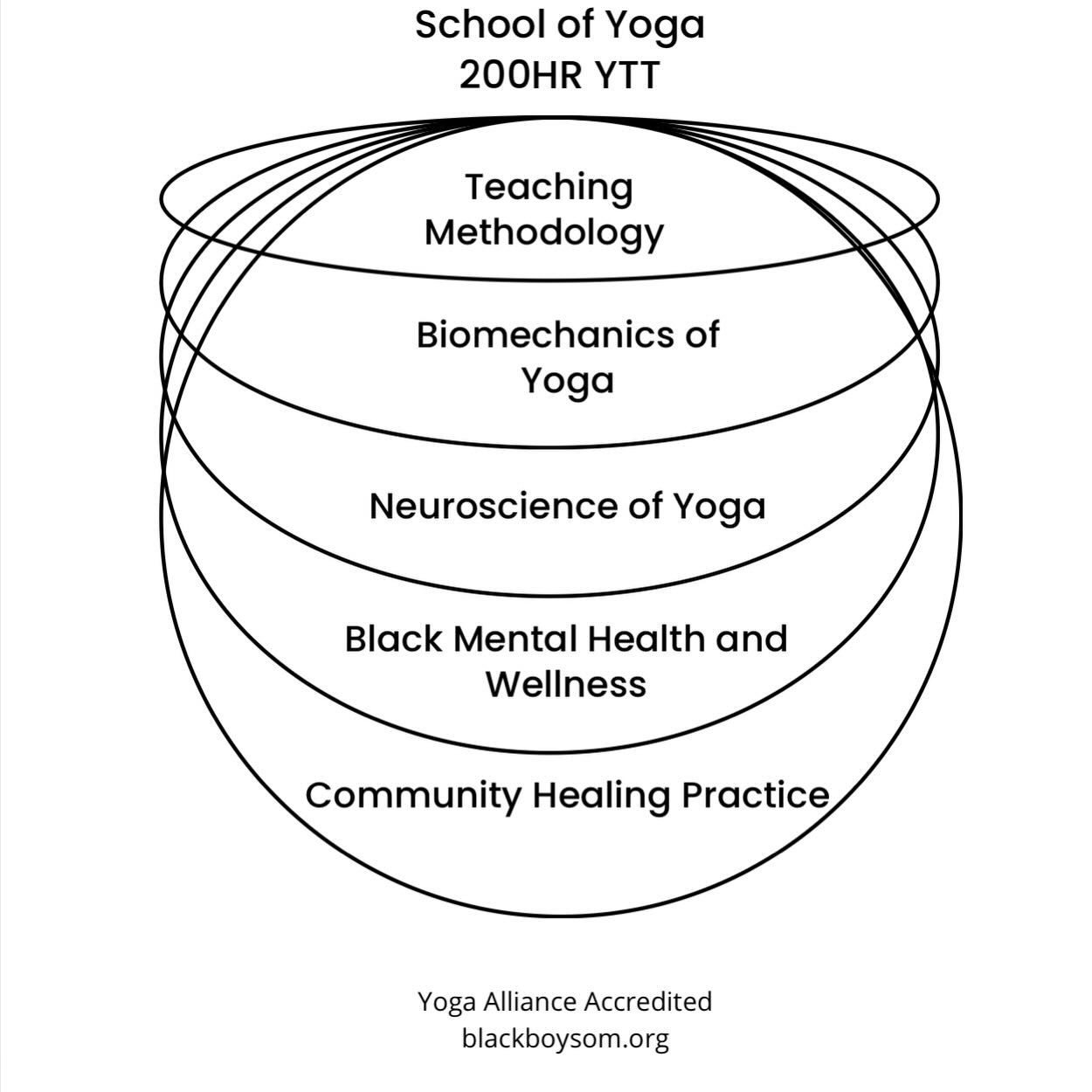
Specifically, our 200HR Yoga Teacher Training focuses on the biomechanics and neuroscience of yoga, Black mental health and wellness, and community healing practices.
Biomechanics is the study of how the human body moves through the principles of physics, including the relationship between muscles, bones, joints, alignment, force, and stability. In yoga, biomechanics helps teachers understand safe and effective movement patterns, optimize alignment, and guide students toward sustainable practice.
Through the study of biomechanics, yoga teachers learn how the body moves, adapts, and responds to different postures, allowing them to teach with greater awareness of alignment, function, and safety.
Neuroscience is the study of the nervous system, including the brain, spinal cord, and networks of neurons that influence movement, thoughts, emotions, sensations, learning, and behavior.
In yoga, neuroscience provides insight into how practices such as meditation, breathwork, and mindful movement affect the brain, nervous system, and overall well-being. We are grateful for the professional liscensed clinicians who are also yoga teachers who have allowed us to make this portion of our training possible.
By exploring neuroscience, yoga teachers gain a deeper understanding of how yoga practices support nervous system regulation, mental clarity, emotional resilience, and embodied awareness.
Black Mental Health and Black Wellness are specific areas of focus for our training because, while our training is available to all genders in ethnicities, the ethos of Black Boys OM is rooted in service towards Black Healing and wellbeing.
Community Healing Practice is part of that ethos as well because there is co-regulation, belonging and a felt sense of communal recognition and safety when persons choose mind-body-spirit health modalities in community.
Learn more about our School of Yoga and our 200HR Yoga Teacher Training here.