
- 200HR Yoga Teacher Training
- Barbershop Meditations Book
- Blog
- Yoga Teachers Guide to AI Course
- Black Men's MBSP's Research
- Self Discovery Daily
- Healthy Gummies
- Heal Noir
- Yoga and Black Healing
- 300HR YTT
- A Healing Journal for Black Men
- School of Yoga Visuals
- Reparations and Wholeness
- Ori Yoga
- 2026 Yearly Planner
- Personal Year of Practice
- 200HRYTT ATL
- Our Trainings
- 200HRYTT-STL
- 200HRYTT-Oakland
- Black Boys OM Book Club
- Foundations of Yoga Teacher Training
I am a Futurist


Written by : Danny Angelo Fluker Jr
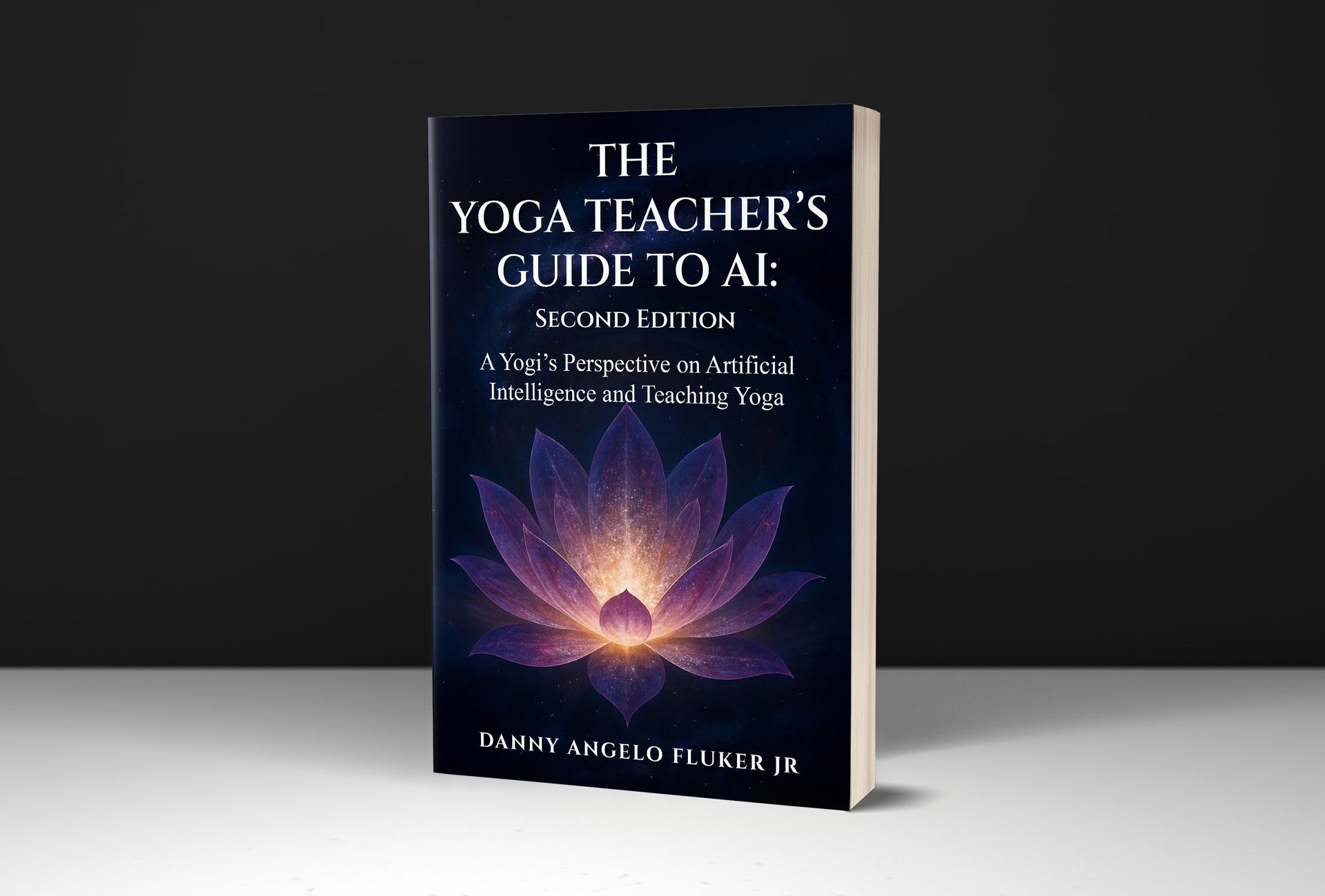
Chapter 13 : Possible Futures (Excerpt) The Yoga Teachers Guide to AI: Second Edition
I am a futurist.
That sentence surprises people sometimes, especially when they meet me through yoga, meditation, or wellness spaces. The popular image of a futurist is often someone tracking tech trends, predicting markets, or speculating about gadgets that have not yet been invented. That work is real, but it is not the whole of it.
A futurist is someone who studies patterns, signals, and systems in order to imagine what could come next. Not just what is likely, but what is possible. A futurist asks how today’s choices ripple forward. Who benefits. Who is harmed. Who is left out. A futurist understands that the future is not a destination we arrive at, but a process we are actively shaping through attention, values, and collective action.
My commitment to futurism begins with community wellbeing. I believe the future of Black people is intimately tied to our collective healing. Not metaphorically. Literally. Our nervous systems, our cultural memory, our spiritual technologies, and our capacity for rest and imagination all determine what futures we can access. When a community is stuck in survival, its future narrows. When a community is resourced to heal, its future expands.
Another expression of my futurist practice is storytelling. I educate and entertain through speculative Afro Futurist fiction in my three book series A Walk in the Night Sun. The series imagines a world five hundred to nine hundred years from now, seen through the lens of Black people across the globe and their lived experience of a world ruling AI. Fiction allows me to ask questions that data cannot answer alone. What does liberation feel like under algorithmic governance. How does memory survive. What spiritual technologies endure. Who gets to define intelligence when machines hold power.
So part of my futurist practice is tending to the conditions that allow Black people to imagine themselves in the future at all. Yoga, meditation, breathwork, storytelling, and communal care are not escapes from the future. They are training grounds for it.
At the same time, I am paying attention to the future as a whole. Humanity is in the middle of a collective reckoning with artificial intelligence. AI will disrupt everything. Work. Education. Creativity. Health. Governance. Spiritual authority. Identity itself. There is no opting out of this moment, only choosing how consciously we engage it.
My lane in that everything is yoga teaching and wellness. I am not here to predict stock prices or design neural networks. I am here to ask what intelligence means in a world increasingly shaped by machines, and what kinds of intelligence we must protect, cultivate, and remember if we want a future that is livable.
That brings us to the idea of alternative intelligence.
When most people hear the word intelligence, they think of IQ, logic, speed, and verbal fluency. This narrow definition has shaped education systems, hiring practices, and now AI development. But intelligence has always been broader than that.
Psychologist Howard Gardner offered a different framework through his theory of multiple intelligences. He proposed that humans express intelligence in many distinct ways. Logical and linguistic intelligence are only two among many. Others include musical intelligence, visual and spatial intelligence, bodily and kinesthetic intelligence, interpersonal intelligence, intrapersonal intelligence, and naturalistic intelligence. Some scholars also suggest pedagogical or digital intelligences.
This matters deeply for yoga teachers and wellness practitioners. Yoga is not primarily a linguistic or logical practice. It is embodied. Kinesthetic. Intrapersonal. Interpersonal. It relies on pattern recognition in sensation, breath, emotion, and energy. When we honor multiple intelligences, we validate the ways wisdom already moves through the body and through community.
Alternative intelligence also shows up in how AI itself is imagined. The dominant model today is based on large language systems that predict patterns in text. Powerful, yes. But not the only possible path. Researchers and thinkers are exploring embodied robotics, artificial life, and systems that emphasize physical perception, social context, and multimodal learning rather than disembodied computation alone.
There is also a growing emphasis on augmented intelligence. These systems are designed to support human judgment rather than replace it. In behavioral health and wellness, this can look like tools that help clinicians notice patterns while still centering human empathy, ethics, and lived experience.
This distinction is crucial. The future does not have to be humans versus machines. It can be humans with tools that respect the fullness of human intelligence.
Wellness sits at the center of this conversation. AI already intersects with mental health through apps, diagnostics, and research tools. At the same time, there are real concerns about regulation, bias, overreliance, and the outsourcing of self awareness. No algorithm can replace intrapersonal intelligence. No model can meditate for you. No system can feel your breath shift in savasana.
Yoga philosophy has always taught that intelligence lives within awareness itself. Not just in thinking, but in perceiving. In listening. In integrating.
So as we step into possible futures, I want to offer this chapter as an educational moment. A pause. An invitation to expand how we define intelligence, how we relate to AI, and how we locate our own authority as teachers and practitioners. The future is being written right now, and your nervous system, your pedagogy, and your presence are already part of it.
Let’s explore what kind of future we are practicing into being.
The Yoga Teachers Guide to AI: Second Edition will be available December 31st. Learn more : dannyspeakspeace.com